

7 Essential Maintenance Tips for Commuter E-Bikes
Table of Contents
- 1. Start With an E-Bike Maintenance Checklist and Pre-Ride Check
- 2. How to Clean an Electric Bike Without Damaging the Electrics
- 3. How to Maintain an Electric Bike Battery for a Long Lifespan
- 4. Check Tyre Pressure, Tread Wear and Brake Feel Before Every Commute
- 5. Lubricate the Chain and Look After the Drivetrain
- 6. Check Bolts, Cables and Electrical Connectors for Wear and Tear
- 7. E-Bike Service Intervals: What to Book and When
- Troubleshooting: When to Fix It Yourself and When to Book a Professional Service
- Frequently Asked Questions
Last Updated: October 12, 2026
1. Start With an E-Bike Maintenance Checklist and Pre-Ride Check
A commuter e-bike maintenance checklist is a short, repeatable set of checks you run before and after every ride. It takes five minutes and prevents most of the breakdowns that strand riders mid-commute.
For commuter e-bikes, the stakes are higher than for weekend bikes. A failure on a Sunday leisure ride is an inconvenience. A failure on the way to work is a missed shift, a cancelled care visit, or a delivery you cannot complete.
Daily and Weekly Checks for Daily Riding
Pre-ride check (2 minutes, every day):
- Squeeze both brakes: levers should feel firm, not spongy
- Spin both wheels: listen for rubbing or grinding
- Check tyre pressure by pressing your thumb into the tread
- Confirm lights switch on and the battery is charged
- Rock the bike side to side: no rattles from loose bolts
Weekly check (10 minutes):
- Wipe the chain and apply lubricant
- Inspect tyres for cuts, glass, or embedded debris
- Test the gears through the full range
- Check brake pad thickness
- Wipe down the frame and battery contacts
2. How to Clean an Electric Bike Without Damaging the Electrics
Never use a high-pressure washer on an e-bike. Pressurised water forces past seals and into motor housings, battery terminals, and controller connections, and the corrosion that follows is expensive to fix. Clean with a bucket, a soft brush, and low-pressure water instead.
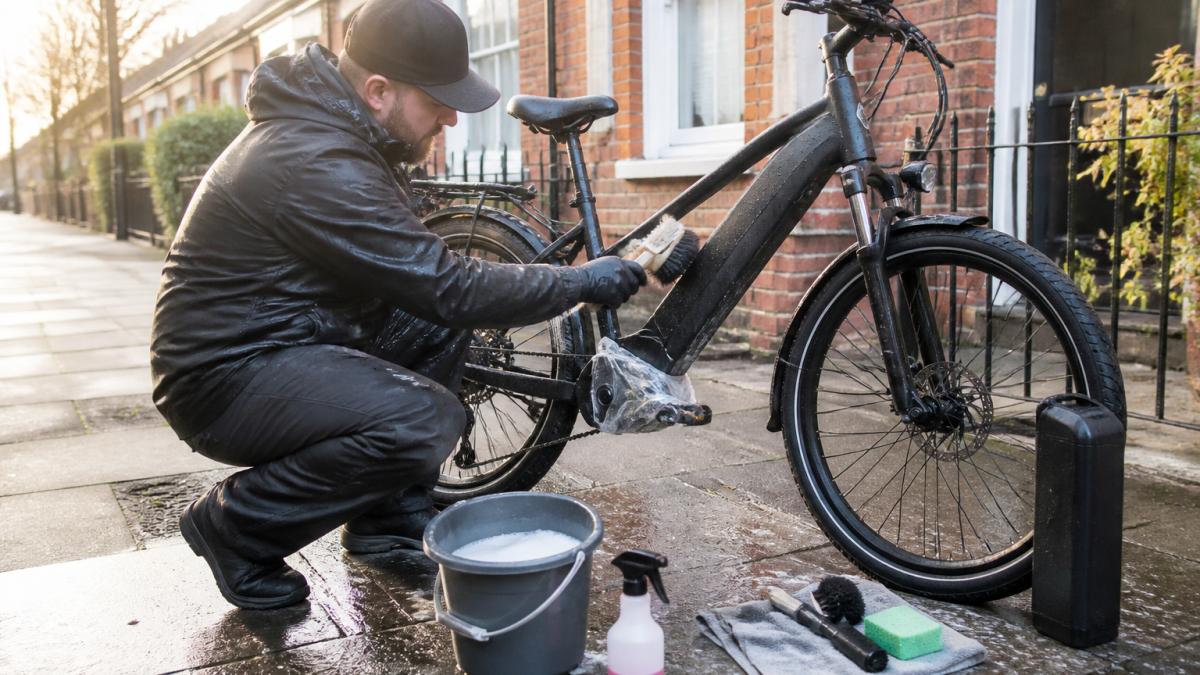
For commuter e-bikes ridden daily through British weather, a weekly wash keeps grit out of the drivetrain and makes every other maintenance task easier. The government's cycle safety and maintenance guidance is a useful starting point for riders new to bike care.
Step-by-step cleaning routine:
- Remove the battery and store it indoors, away from water
- Rinse the frame with a gentle hose or watering can, never a jet wash
- Apply bike-specific cleaner to the frame and drivetrain
- Scrub with a soft brush, working top to bottom
- Rinse thoroughly and dry with a microfibre cloth
- Recharge and refit the battery once the terminals are dry
Cleaning the Chain, Cassette and Drivetrain
The drivetrain collects the most dirt and deserves the most attention. A dedicated cleaner makes short work of dried-on grime. We stock the Mint Chain Cleaner 500ml Spray Can (£7.49), which dissolves contaminated chain lube and dried oil, and its emulsifying formula rinses away cleanly. It is suitable for chains, sprockets, and O, X and Z rings.

Spray the cassette and chain, let it sit briefly, then agitate with a soft brush before rinsing. Never point water directly at the motor, controller, or battery mount.
3. How to Maintain an Electric Bike Battery for a Long Lifespan
Battery care is the single biggest factor in how long your commuter e-bike stays economical to run. A replacement battery is the most expensive consumable on the bike, so the habits below pay for themselves.
Charging habits that extend battery life:
- Charge between 20% and 80% for everyday commuting, not to 100% every time
- Avoid leaving the battery at 0% or 100% for long periods
- Charge at room temperature, not in a cold shed or a hot car
- Use the charger supplied with the bike, not a generic substitute
Storage for commuters who ride seasonally:
- Store at around 50-60% charge if the bike will sit for weeks
- Keep the battery indoors, dry, and away from frost
- Recharge to 50-60% every two to three months during storage
A 50+ mile range holds up well when these habits are followed. If your range drops noticeably, our Leicester showroom offers battery testing as part of our after-care service.
4. Check Tyre Pressure, Tread Wear and Brake Feel Before Every Commute
Tyre pressure affects range, grip, and puncture risk more than any other single factor on a commuter e-bike. Under-inflated tyres roll slower, drain the battery faster, and pinch-flat more easily on potholed roads.
What to check and how often:
| Check | Frequency | What Good Looks Like |
|---|---|---|
| Tyre pressure | Every ride | Firm to thumb pressure, matched to sidewall rating |
| Tread wear | Weekly | Visible tread pattern, no bald patches |
| Sidewall condition | Weekly | No cracks, bulges, or embedded glass |
| Brake lever feel | Every ride | Firm, consistent, no sponginess |
| Brake pad thickness | Monthly | More than 1mm of pad material remaining |
A track pump with a gauge takes the guesswork out of pressure. The Oxford Air Pump Gauge Twin Head (£25.00) handles both Presta and Schrader valves and reads up to 160 PSI, so it works across a household of bikes.

When tread wears thin or sidewalls crack, replace rather than repair. Our G Hybrid Tyre Size 20x2.125 with Reflective Line and Puncture Guard (£19.99) suits most 20-inch rims and is recommended for e-bikes.
5. Lubricate the Chain and Look After the Drivetrain
A clean, lubricated chain shifts better, lasts longer, and puts less strain on the motor. Chain wear is a common drivetrain problem, and it is almost always preventable.
Lubrication routine:
- Clean the chain first, using a degreaser and brush
- Dry the chain thoroughly
- Apply lubricant to the inside of the chain while turning the pedals backwards
- Wipe off excess with a cloth
- Let it settle before riding
For year-round commuting, a weather-resistant lubricant matters. The Oxford Mint All Weather Lube 500ml (£7.99) uses corrosion-inhibiting additives and PTFE to create a film that extends maintenance intervals, with anti-fling properties suited to longer journeys.
Mint Chain Cleaner 500ml Spray Can →

Check for chain stretch monthly using a chain checker. A worn chain wears out the cassette and chainring, turning a cheap replacement into an expensive one. If shifting feels vague or the chain skips under load, the chain is likely past its service life.
6. Check Bolts, Cables and Electrical Connectors for Wear and Tear
Loose fasteners and corroded connectors cause more commuter breakdowns than motor failures. Vibration from daily riding gradually loosens bolts, and British weather works on every exposed contact.
Monthly bolt check:
- Stem and handlebar clamp bolts
- Seat post clamp and saddle rails
- Rack, mudguard, and kickstand mounts
- Crank arms and pedal threads
- Motor mount bolts, where accessible
Use a torque wrench where the manufacturer specifies a figure. Overtightening carbon or alloy components causes cracks that fail without warning.
Cables and connectors:
- Inspect brake and gear cables for fraying at the lever and calliper ends
- Check outer cable housing for splits that let water in
- Unplug and inspect battery and motor connectors for corrosion or green residue
- Apply a dielectric grease to clean, dry contacts before reconnecting
If a brake inner wire is frayed or stiff, replace it. The Clarks Galvanised Road/MTB Brake Wire (£7.49) is a 2000mm galvanised inner wire compatible with e-bikes, MTB, road, and hybrid systems.
7. E-Bike Service Intervals: What to Book and When
An e-bike service interval is the scheduled point at which a qualified mechanic inspects the parts you cannot easily check at home. For daily commuters, we recommend a professional service every six months or 1,000 miles, whichever comes first.
What a service typically covers:
- Full drivetrain inspection and adjustment
- Brake system check, including hydraulic bleeding where fitted
- Wheel truing and spoke tension
- Battery health and electrical system diagnostics
- Firmware and controller checks on compatible models
- Safety inspection of frame, forks, and mounts
Heavier use shortens the interval. Delivery riders and care workers covering long daily distances should book every three to four months. Riders who only commute short distances in dry conditions can often stretch to annual servicing.
Model-specific schedules matter. Always check your handbook and warranty terms before authorising work, because some warranties require servicing at set intervals by an approved provider. Our UK after-care service includes e-bike repairs, servicing, battery testing, and local warranty support.
Troubleshooting: When to Fix It Yourself and When to Book a Professional Service
Most routine tasks, cleaning, lubricating, checking pressure, and tightening bolts, are well within reach for any rider. The line to draw is anything involving the electrical system, hydraulics, or structural components.
Fix it yourself:
- Cleaning the frame and drivetrain
- Lubricating the chain
- Adjusting tyre pressure
- Tightening accessible bolts to spec
- Replacing inner tubes and tyres
Book a professional:
- Any battery fault, swelling, or unexplained range loss
- Motor cutting out, grinding, or losing power
- Hydraulic brake bleeding or persistent sponginess
- Wheel truing and spoke replacement
- Cracked frame, fork, or component
- Repeated electrical faults after connector cleaning
If a symptom returns after you have addressed the obvious cause, stop riding and get it inspected. Electrical faults on e-bikes rarely fix themselves, and continuing to ride can turn a minor repair into a battery or controller replacement.
Frequently Asked Questions
How often should I service my commuter e-bike?
Most commuter e-bikes benefit from a basic check every week and a professional service every 6 to 12 months, depending on how many kilometres you cover. If you ride daily in wet or gritty conditions, book a service closer to the six-month mark. A typical service covers brakes, drivetrain, tyre condition, bolts, electrical connectors and a battery health check, so issues are caught before they leave you stranded mid-commute.
How do I maintain an electric bike battery so it lasts longer?
Store the battery between roughly 20% and 80% charge for everyday use, and top it up to full only before a long ride. Keep it out of extreme cold and avoid leaving it plugged in for days after it has finished charging. Charge in a dry, room-temperature spot rather than a cold shed. If your commute is short, you do not need to charge after every single trip, and this alone can slow long-term capacity loss.
Should I charge my e-bike battery after every ride?
Not necessarily. If you have only used a small part of the range, waiting until the battery drops to around 30-40% before recharging is kinder to the cells. Charge fully the night before a long commute or a weekend ride. Frequent top-ups from 90% to 100% add unnecessary charge cycles over time, which shortens the battery's useful lifespan.
How do I clean an e-bike without damaging the electrics?
Remove the battery first, then wipe the frame with a damp cloth and mild soap. Use a soft brush for the chain, cassette and jockey wheels, and apply a dedicated degreaser such as a chain cleaner spray rather than a strong jet of water. Never point a high-pressure hose at the motor, display, connectors or battery mount, and dry everything with a microfibre cloth before refitting the battery.
Can I ride an e-bike in the rain, and what should I check afterwards?
Yes, most commuter e-bikes are built for wet weather, but water and grit accelerate wear. After a wet ride, wipe the chain, reapply a wet-weather chain oil, and dry the frame and electrical connectors. Check brake pads for grit and re-test brake feel before your next trip. If you ride in the rain regularly, shorten your cleaning and lubrication intervals and book a service sooner than the standard 12 months.
Commuting by e-bike only stays cheap and reliable when maintenance is a habit, not a reaction. If you would rather hand the job to someone who knows these bikes inside out, Green Hybrid Bikes offers UK-wide delivery, a Leicester showroom for free test rides, and after-care that includes servicing, battery testing, and warranty support. Browse our commuter e-bikes online or book a free e-bike test ride and let us help you choose the right model for your daily route.
