

Best Folding E-Bikes for Small Apartments: 2026 Guide
Table of Contents
- Quick Comparison: Folding E-Bikes for Small Flats
- What to Look For in a Folding E-Bike
- Lightweight Folding E-Bikes for Commuting
- How to Store an E-Bike in a Small Flat
- E-Bike Battery Safety and Storage Regulations
- The Models That Fit Small Apartments Best
- Verdict: Which Folding E-Bike Suits Your Flat?
- Frequently Asked Questions
Last Updated: September 25, 2026
Quick Comparison: Folding E-Bikes for Small Flats
The best folding e-bikes for small apartments balance folded size, carry weight, and one-handed hinge operation.
What to Look For in a Folding E-Bike
The deciding factor is folded footprint, not wheel size or motor wattage. A folder with wheels of a common size collapses to roughly the length of a large suitcase, the practical limit for most hallway storage.
Work through this checklist before you buy:
- Folded dimensions and shape: Measure your storage spot first. A folded bike is long and narrow, not square.
- Weight: Most folding e-bikes sit between 21 kg and 26 kg. Anything under 22 kg is manageable for a fit adult on stairs.
- Hinge mechanism: Look for a two-click or quick-release latch you can operate one-handed.
- Step-through frame: Easier to mount in a corridor and kinder on knees and hips.
- Battery integration: A detachable battery lets you charge indoors without carrying the whole bike.
- Brake performance: Disc brakes front and rear give you confidence in wet city traffic.
- Tyre clearance and size: Wider tyres absorb potholes and kerbs better than narrow ones.
Lightweight Folding E-Bikes for Commuting
Lightweight folding e-bikes for commuting prioritise carry weight and folding speed over range. If your journey involves stairs, a lift, or a train, a bike you can lift cleanly beats one with a bigger battery you dread hauling.
How to Store an E-Bike in a Small Flat
Learning how to store an e-bike in a small flat comes down to one principle: store it vertically or in dead space, never in the middle of a room. A folded bike leaning against a hallway wall takes less floor area than a shoe rack; hung vertically, less than a broom.
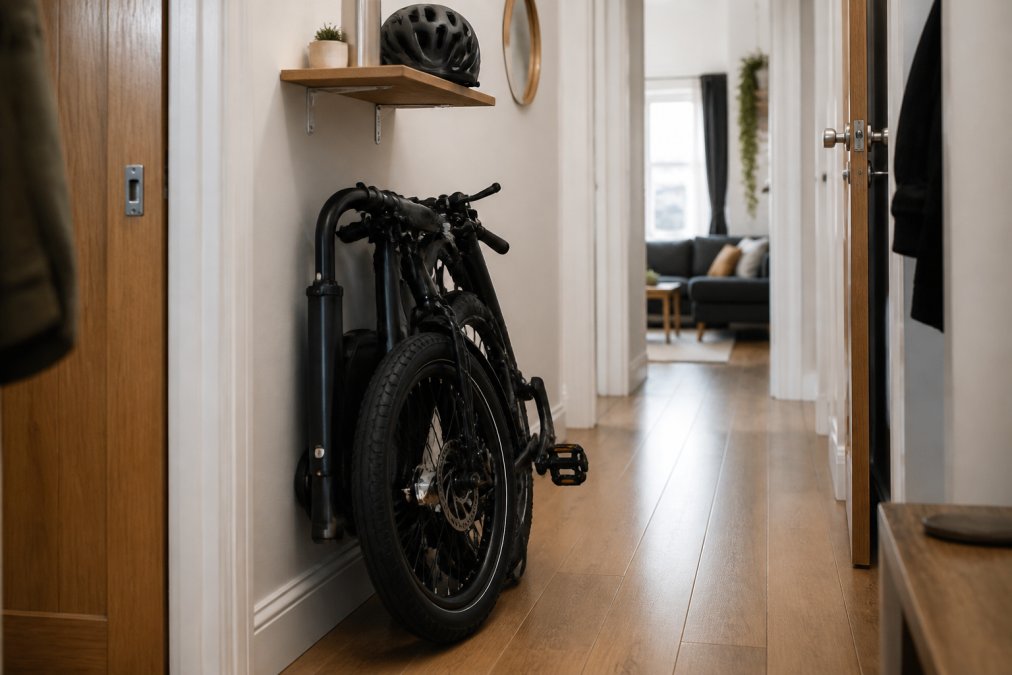
Vertical storage: the technique most guides skip
Most folding e-bikes stand on their folded base, but that still leaves a suitcase-sized footprint. Turning the bike 90 degrees and hanging it by the rear wheel reduces that to the width of the tyre plus the handlebar, typically 25-35 cm of wall space.
What actually works:
- Rear-wheel hook: A hook rated to at least 1.5 times the bike's weight (35 kg minimum for a 21 kg folder), fixed into a stud or masonry wall with the correct anchor. Hang by the rear rim, not the tyre.
- Two-point wall rack: A vertical rack with a lower cradle for the front wheel and an upper hook for the rear keeps the bike parallel to the wall and stops it swinging into the door swing.
- Floor-to-ceiling pole: Useful in rented flats where you cannot drill into masonry. It tensions between floor and ceiling and carries a pair of hooks, but check the ceiling is solid, plasterboard will not hold a 21 kg bike.
- Under-stair wedge: The triangular void under a staircase is often the largest unused volume in a flat. A folded bike slid in sideways fits where nothing else will.
Stair-carry ergonomics
If your flat is above the ground floor, the carry matters more than the fold. A 21 kg bike carried badly feels like 30 kg by the third flight.
The technique that works:
- Find the balance point. On most folders this sits just behind the main hinge, roughly a third of the way along the folded frame. Grip there with one hand and the opposite end with the other.
- Carry against the hip, not out in front. Holding the bike close to your centre of gravity stops it swinging and takes the load off your lower back; carrying it at arm's length is the most common mistake.
- Use the folded shape. Tuck it under one arm like a large suitcase on the narrow side of a staircase, keeping your free hand on the banister.
- Go one step at a time on tight turns. Taking a folded bike up a spiral or half-landing two steps at a time is how hinges get bent and shins get scraped.
Security when the bike lives indoors
Storing a bike inside your flat removes most theft risk, but introduces two others: damage to your deposit, and the shared bike room problem if you use one.
- Shared cycle stores: The highest-risk location for a folding e-bike, because a folder is easy to pick up and walk away with. Use a Sold Secure-rated lock (Gold or Diamond) through the frame and a fixed ground anchor, and remove the battery if it detaches. Check whether your contents insurance covers the store, many policies exclude communal storage unless the bike is locked to a fixed point.
- Indoor security: A folding e-bike kept inside is generally covered by standard contents insurance, but check the policy's definition of 'bicycle' and whether e-bikes are treated separately. Some insurers require the battery to be stored a set distance from sleeping areas or exclude fire damage caused by charging.
- Deposit protection: Wall hooks and poles leave holes. If you rent, get written permission before drilling, or use a pole or freestanding rack. Patch and paint before you move out.
- Marking and registration: Record the frame number, photograph the bike, and consider a recognised bicycle marking scheme. It will not stop a theft, but it helps with recovery and insurance claims.
Before you buy any mount, fold the bike and measure it yourself with a tape measure. Manufacturer folded dimensions are usually quoted without the pedals, the handlebar stem or the seat post, and those are exactly the parts that stop it fitting in the gap you had in mind.
E-Bike Battery Safety and Storage Regulations
E-bike battery safety and storage regulations in the UK focus on charging practice and fire risk, and are stricter than many new owners expect. Lithium batteries must be charged with the manufacturer's charger, and you should never leave a charging battery unattended overnight or in a hallway that blocks your escape route.
Folding e-bike with Discrete Seat Post →
The charging rules that matter in a flat
A flat presents a specific problem: no garage, no shed, no outdoor socket, so the battery charges in the same space you sleep and eat. That makes the following non-negotiable:
- Charge in a room with a working smoke alarm, ideally not a bedroom and never in the only escape route.
- Never charge a battery that shows swelling, damage, or water ingress.
- Unplug once the charge cycle finishes; most models take four to six hours.
- Store the battery at room temperature, away from direct sunlight and radiators.
- Use only the original charger for your specific model.
- Do not charge a battery still hot from a ride, let it cool for 30 minutes first.
- If you must charge overnight, use a room you can close off from the rest of the flat, and never a soft surface like carpet or a bed.
What the regulations actually cover
For guidance on fire safety in the home, the Home Office fire safety guidance sets out general prevention advice, and product safety requirements for e-bike batteries are covered by Office for Product Safety and Standards guidance. In practice, the rules that affect you as a flat owner or renter fall into three buckets:
- Product safety: Batteries and chargers sold in the UK must meet relevant product safety requirements. A cheap aftermarket charger not tested to the same standard is a common cause of battery fires.
- Building regulations and fire safety: In a block of flats, communal areas prohibit storing or charging e-bikes and batteries in corridors, stairwells and escape routes, whether you own or rent.
- Tenancy and lease terms: Many tenancy agreements and leasehold covenants now include clauses about e-bike charging and storage. Check yours before installing a wall mount or charging in a shared space.
Insurance and liability
This is the part most guides leave out. If a battery fire starts in your flat, who pays depends on your insurance and your lease.
- Contents insurance: Check whether e-bikes and batteries are covered, and whether you must charge in a specific location or use the manufacturer's charger. Some policies exclude fire damage caused by charging a non-original battery.
- Buildings insurance: In a block of flats, buildings insurance is usually held by the freeholder or management company. A fire caused by your battery could lead to a claim against you, so understand your liability before an incident.
- Shared cycle stores: If you charge in a communal store, check the building's rules and whether your contents insurance covers the bike there. Many policies exclude communal storage unless the bike is locked to a fixed point.
- Landlord requirements: If you rent, your landlord may require charging in a specific room or a fireproof charging bag. Comply, it is usually a condition of the tenancy.
Never charge an e-bike battery in a communal hallway, stairwell or shared cycle store unless the building's rules explicitly permit it. A battery fire in an escape route is the worst-case scenario, and it is the reason so many blocks have banned charging in communal areas.
For a small flat, the safest setup is a detachable battery, charged in a room with a smoke alarm, using the original charger, on a hard surface, while you are awake. Everything else, wall mounts, vertical storage, shared stores, is secondary to getting the charging routine right. Once you have secured your charging protocol, you can integrate your bike into your living space more effectively by exploring various small apartment storage hacks that maximize your remaining square footage.
The Models That Fit Small Apartments Best
The models that fit small apartments best have a folded footprint under a metre and a weight you can lift without help. Here's how our current range compares on the specs that matter for flat living.
| Model | Price | Weight | Battery & Range | Best For |
|---|---|---|---|---|
| G-Hybrid City Folding E-Bike | £649 | 21 kg | 36V 10Ah, up to 30 miles | Tight budgets, first folders |
| Freedom Folding E-Bike (Lower Step) | £799 | 21.5 kg | 36V 10Ah, up to 30 miles | Easier mounting, comfort |
| G-Hybrid Crosscity | £899 | 21.5 kg | 36V 8.8Ah, up to 30 miles | Discreet seat-post battery |
| Volta VB2 Folding Fat Tyre | £799 | 26 kg | 48V 10Ah, up to 30 miles | Rough surfaces, stability |
| G-Hybrid Dyno Folding Fat Tyre | £999 | 24.5 kg | 48V 15.6Ah, up to 40 miles | Longer rides, mixed terrain |
Verdict: Which Folding E-Bike Suits Your Flat?
Match the bike to your storage reality, not the spec sheet. With a narrow hallway and a first-floor flat, the G-Hybrid City Folding E-Bike at £649 or the Freedom Folding E-Bike at £799 will serve you better than a heavier fat tyre model you avoid carrying.


Frequently Asked Questions
What are the most compact folding electric bikes for small flats?
The most compact options use common wheel sizes and a single-hinge frame. The G-Hybrid City range folds to roughly the footprint of a suitcase, weighs 21 kg, and costs £649. The Freedom and Crosscity models offer the same folding geometry with a step-through frame or a seat post battery, both at £799 and £899. Measure your hallway and cupboard door widths before buying, then check the folded dimensions against that gap.
How much storage space do I need for a folding e-bike?
A folded e-bike needs roughly the floor space of a medium suitcase, about 80 cm by 40 cm. That fits inside a hallway cupboard, behind a door, or in a vertical rack. If you store it vertically, you free up almost all floor space. Allow an extra 20 cm on each side so you can lift the frame in and out without scraping walls or skirting boards.
Are folding e-bikes reliable for daily commuting?
Yes, if you keep on top of the folding hinge. Check the hinge clamp for play every few weeks and keep it clean and lightly greased. Book a service once a year to check the hinge, brakes and battery connections.
Do folding e-bikes meet UK EAPC regulations?
The G-Hybrid folding range complies with UK EAPC rules: 250W maximum motor power and 15.5 mph assisted speed limit. Riders must be 14 or over. Any derestriction makes the bike illegal for road use and voids the warranty. Check the legal notice on each model page before you buy.
How heavy are folding electric bikes on average?
Most folding e-bikes weigh between 21 kg and 26 kg. The G-Hybrid City and Freedom models sit at 21 kg and 21.5 kg, while the fat tyre Dyno and Husky models reach 24.5 kg to 26 kg. Weight matters most when carrying the bike up stairs. If you live above the first floor, look at the 21 kg models and use the folded frame as a carry handle.