

E-Bike Shop Alternative for Local Support: 2026 Guide
Table of Contents
- Showroom or Online-Only: What Changes When You Need Local Support
- The Real Cost of Independent Servicing and Local Support
- How to Maintain Electric Bike Battery for Long-Term Reliability
- Electric Bike Maintenance Schedule: What to Check and When
- Finding an E-Bike Service Centre Near Me: What to Look For
- Warranty, Consumer Rights and After-Sales Support Explained
- Choosing a Local Support Alternative: Models and What They Cost
- Conclusion
- Frequently Asked Questions
Last Updated: September 20, 2026
Showroom or Online-Only: What Changes When You Need Local Support
Buying an e-bike online is easy. Getting it fixed is where the trouble starts. This guide from Green Hybrid Bikes looks at what changes when you need local support, and how to avoid the dead ends that catch out first-time buyers.
The Real Cost of Independent Servicing and Local Support
Independent workshops charge by the hour, and e-bike labour rates sit higher than standard bicycle rates because the work involves electrical diagnostics as well as mechanical repair. A typical independent e-bike service lands between £60 and £120 depending on region and stripping-down, with electrical fault-finding billed separately at a higher rate. Complexity increases significantly when dealing with high-voltage systems, necessitating a more rigorous approach to electric drivetrain diagnostics that ensures both rider safety and long-term component reliability.
The costs stack up in four places, not three:
- Routine servicing to keep the bike safe and reliable
- Diagnostics when the motor, controller or sensor throws a fault
- Parts when something wears out and needs a specific component
- Downtime, the cost nobody quotes you, but the one that hurts most if the bike is your commute
What actually drives the bill up
Two things separate a cheap service from an expensive one: how proprietary the bike is, and whether the workshop knows the system.
- Universal components, tyres, tubes, brake pads, chains, cassettes, cables, bearings, saddles, grips and most mechanical drivetrain parts are standard bicycle items. Any competent workshop can source and fit them, and you can buy them yourself from any bike shop.
- Proprietary components, motor controllers, torque sensors, cadence sensors, display units, battery management systems and motor-specific cabling are usually brand-locked. They often can only be supplied through the brand's own distribution chain, which means longer lead times and higher prices.
Total cost of ownership over three years
Sticker price is the least useful number here. A more honest comparison looks at what the bike costs to keep on the road:
| Cost line | Cheaper online-only bike | Showroom-backed bike |
|---|---|---|
| Purchase price | Lower | Higher |
| First service | You arrange and pay | Often included or discounted |
| Diagnostics on a fault | Paid, plus travel if no local access | Handled in-house |
| Proprietary parts | Sourced by you, at retail | Sourced by the seller |
| Downtime per fault | Days to weeks | Usually days |
| Resale value | Lower without service history | Higher with documented servicing |
Insurance and liability
Most guides skip this. Using a non-authorised workshop does not automatically lose your statutory rights, those sit with the retailer under the Consumer Rights Act 2015 and cannot be signed away. But a manufacturer's voluntary warranty can be affected if a repair caused the fault you are claiming for, and some policies require servicing by a competent person with records kept.
Check two things before booking any independent repair:
- Whether your home or cycle insurance requires servicing by an approved agent
- Whether the manufacturer's warranty terms specify approved servicing, and what evidence they expect
How to Maintain Electric Bike Battery for Long-Term Reliability
Battery care is the biggest factor in how long your e-bike stays useful.
Here's what actually works:
- Charge between 20% and 80% for everyday use, and only charge to 100% before a long ride
- Store at around 50-60% if the bike won't be used for weeks
- Keep it out of extreme cold, which temporarily reduces range and stresses the cells
- Charge indoors at room temperature, not in an unheated garage in winter
- Never leave it plugged in for days after it's full
- Check the charger and connectors for heat or fraying
Electric Bike Maintenance Schedule: What to Check and When
An electric bike maintenance schedule separates bikes that last from bikes that fail early. Most mechanical failure is predictable, and therefore preventable.
| Interval | Check | Why It Matters |
|---|---|---|
| Before every ride | Tyre pressure, brakes, lights, battery charge | Catches safety issues before they strand you |
| Weekly | Chain lubrication, quick-release bolts, cable tension | Prevents drivetrain wear and loose components |
| Monthly | Brake pad wear, gear indexing, tyre tread | Keeps shifting smooth and stopping reliable |
| Every 6 months | Full service, battery health check, torque settings | Catches wear you can't see |
| Annually | Frame integrity inspection, electrical system diagnostics | Confirms the bike is still safe and legal |
Finding an E-Bike Service Centre Near Me: What to Look For
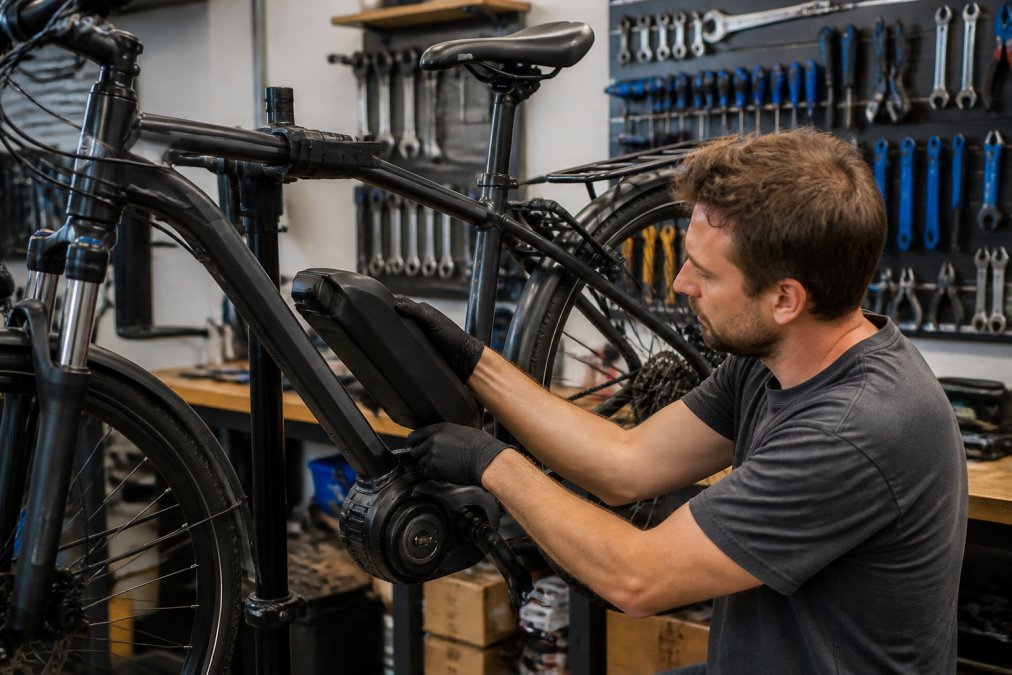
The best service centre is one that will actually work on your bike, not just the brands it sells.
A vetting checklist for independent mechanics
Most buyers vet independent mechanics badly: they pick the closest shop and hope for the best. Treat the first conversation as an interview:
Freedom Folding e-bike with Lower Step →
- Confirm they have hands-on experience with your specific motor and battery system, not just e-bikes in general
- Ask which diagnostic tools they use and whether they can read fault codes from your system
- Ask whether they carry or can source spare parts for your model, and typical lead times
- Confirm they can handle electrical diagnostics, not just mechanical work
- Ask how they document the work and whether you receive a written report
- Ask about warranty implications before any repair begins
- Request a written quote before work starts, including diagnostic time
- Ask what happens if the fault turns out to be a warranty matter, will they hand the bike back, or proceed and bill you?
Authorised agents versus independents
Both models work, for different jobs:
- Mechanical work (brakes, gears, chains, tyres, bearings): any competent workshop
- Electrical diagnostics (motor, controller, sensors, display): a workshop with the right software and cables
- Warranty work: an authorised agent, or the retailer you bought from
What to do if there is no local option
If the nearest qualified workshop is an hour away, plan around it. Book services in advance, combine them with other trips, and keep universal spares, tubes, brake pads, a chain, so a minor issue doesn't become a lost week. For electrical faults, contact the retailer first: under the Consumer Rights Act 2015 the seller is responsible for remedies on faults present at purchase, and a good seller will coordinate the repair rather than leave you to find a workshop alone.
Warranty, Consumer Rights and After-Sales Support Explained
Your statutory rights sit with the retailer, not the manufacturer. Under the Consumer Rights Act 2015, goods must be of satisfactory quality, fit for purpose, and as described. If an e-bike fails early from a fault present at purchase, the retailer must put it right.
Choosing a Local Support Alternative: Models and What They Cost
A local support alternative means buying from a seller who can also service what they sell. That's the model Green Hybrid Bikes operates: an online shop with a Leicester showroom, free test rides, and UK after-care covering repairs, servicing, battery testing, assembly, and safety inspections.
Here's how the options compare:
| Model | Upfront Cost | Servicing | Warranty Support | Best For |
|---|---|---|---|---|
| Online-only marketplace | Lowest | You arrange it | Slow, remote | Confident DIY owners |
| Brand-direct online | Mid | Authorised agents | Moderate | Riders near an agent |
| Showroom with after-care | Mid to higher | In-house | Direct and local | Commuters needing reliability |
Conclusion
The hardest part of buying an e-bike isn't choosing one. It's knowing who'll look after it in year two.
Frequently Asked Questions
Why do some local bike shops refuse to work on e-bikes?
Many independent workshops lack diagnostic software and training for proprietary motor systems, so they turn away e-bikes rather than risk damaging them. Others worry about liability if a battery or controller fails after they have touched it. This is why buying from a retailer with its own after-sales support, such as a showroom with a workshop, saves you the hassle of ringing round for a mechanic who will actually take the job.
How do I find a qualified e-bike mechanic near me?
Start with the retailer you bought from. A showroom-backed service centre will have trained staff and the right diagnostic tools. If you bought online, ask the retailer which local partners they work with. When vetting an independent workshop, ask whether they carry insurance for e-bike repairs, hold manufacturer training certificates, and can source spare parts for your motor and battery. A quick phone call saves a wasted journey.
Can I get my electric bike serviced at a standard cycle shop?
Some standard cycle shops will handle mechanical jobs such as brakes, gears and tyres, but they often cannot touch electrical system diagnostics, firmware updates or battery repairs. If your bike needs motor or battery work, you need a workshop with e-bike specific tools and training. Checking ahead avoids leaving your bike somewhere that cannot complete the job.
What are the benefits of buying an e-bike from a showroom versus online?
A showroom lets you test ride before committing, which matters for sizing, comfort and hill assistance. You also get in-person handover, a fitted bike, and a local point of contact for warranty claims and servicing. Online-only sellers may undercut on price, but you carry the risk of arranging your own assembly, diagnostics and repairs. If local support matters to you, a showroom purchase usually pays for itself in convenience.
What should I look for in a local e-bike service centre?
Look for a workshop that stocks or can order spare parts for your specific motor and battery, uses diagnostic software for electrical faults, and offers a clear service interval plan. Ask about turnaround times, labour rates and whether they handle warranty claims on behalf of the manufacturer. A centre that also sells e-bikes will usually have deeper knowledge of the systems than a general repair shop.