

Commuter Electric Bikes: A 2026 Buyer's Guide
Table of Contents
- What Makes a Commuter Electric Bike Different?
- Motor Power, Battery Range, and Charging: What You Actually Need
- Comfort, Safety, and Practicality for Daily Rides
- Commuter Electric Bikes and the EAPC Regulations UK
- Cut Commute Costs with the Electric Bike Cycle to Work Scheme
- The Best Electric Bike Accessories for Commuters
- The Real Cost of Commuting by E-Bike
- Frequently Asked Questions
Last Updated: September 9, 2026
What Makes a Commuter Electric Bike Different?
A commuter electric bike is built for daily transport, prioritising reliability, weather resistance, and practical accessories over off-road capability or racing geometry. Unlike a leisure e-bike, these come standard with integrated lighting, mudguards, and rack mounts, so you arrive clean and dry without buying extras. The upright frame geometry improves visibility in traffic and reduces strain on your back and wrists.
The real distinction is the components. Commuter electric bikes typically use a hub or mid-drive motor with puncture-resistant tyres and hydraulic disc brakes for stop-start urban riding. Most guides focus on top speed, but the genuine value lies in how the bike behaves at 15 mph in the rain with a laptop on the rack. Commuters need a machine that starts first time, every time, in British weather.
Motor Power, Battery Range, and Charging: What You Actually Need
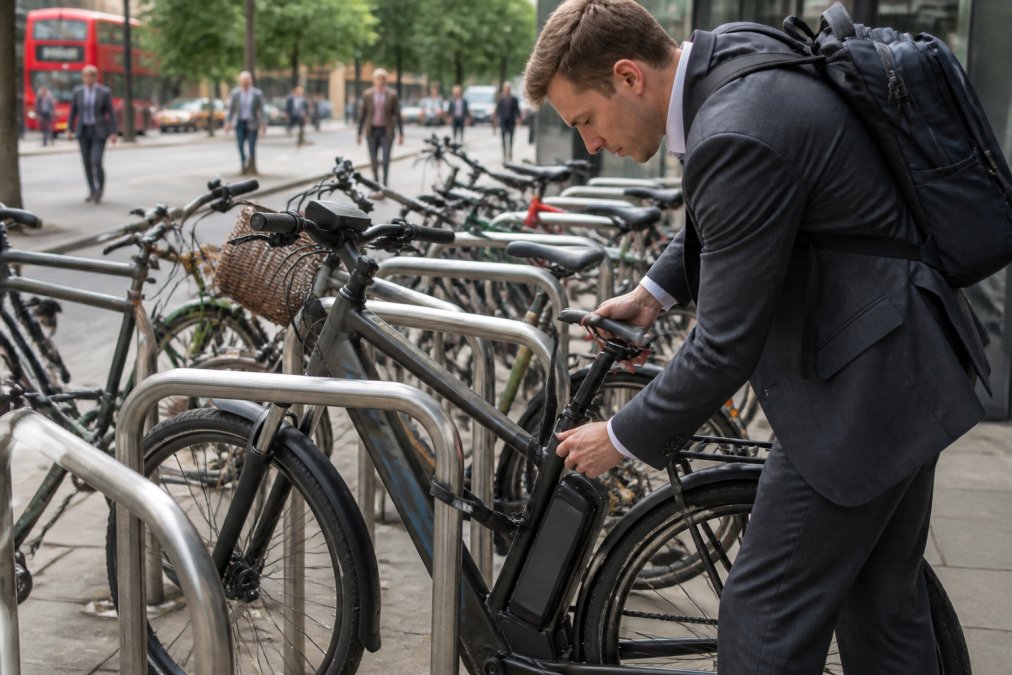
For UK roads, the practical benchmark is a motor delivering consistent pedal-assist up to the legal limit and a battery that covers your round trip with reserve to spare. Most daily commutes fall between 5 and 15 miles each way, so a battery offering a real-world range of 40 to 60 miles removes any worry about range anxiety, even in winter when cold saps capacity. Look for a removable battery, as this lets you charge at your desk and protects the cells from freezing overnight.
Charging time is another overlooked factor. A full charge takes four to six hours, so reaching 80 percent in two to three hours suits those who forget to plug in overnight. Avoid fixating on watt-hours or peak torque; a torque sensor, which responds proportionally to pedalling, feels more natural than a lurching cadence sensor and extends range. The sweet spot for many is a mid-drive motor around 250W with a torque sensor and a 500Wh to 700Wh battery.
Comfort, Safety, and Practicality for Daily Rides
Comfort dictates whether you ride daily or leave the bike in the shed. Prioritise a step-through frame if you carry bags or wear work clothes, and a suspension fork to absorb potholes. Ergonomic grips and a padded saddle help on a 30-minute ride, while commuter geometry keeps you upright. Puncture-resistant tyres with decent width handle wet leaves and tram tracks without the constant fear of a flat.
Safety comes from visibility and stopping power. Integrated lighting running off the main battery means you never arrive with dead lights, and hydraulic disc brakes stop reliably in the wet. A throttle-controlled start helps from a standstill on steep junctions, but pedal-assist remains the core of safe riding. For carrying shopping or a change of clothes, check rack compatibility and cargo capacity, as many frames support 25kg rear loads.
The Intermodal Commuting Problem: Trains, Buses, and the Last Mile
Most guides stop at the bike, but the real test is how it fits your entire journey. If your commute involves a train or bus, the 'last mile' problem decides between a standard and a foldable bike. National Rail and most TfL services permit full-size bikes only outside peak hours (before 07:30 and after 09:30), useless for the 9-to-5 worker. A foldable commuter e-bike with 16- or 20-inch wheels, such as those with a 5-second folding mechanism, bypasses these restrictions because it is classed as luggage, not a bicycle, so you can carry it into a carriage, bus, or lift without booking a space.
For full-size frames, the workaround is secure station parking. Many UK stations offer cycle hubs with CCTV and key-card access, but spaces fill early, and leaving a £1,500 e-bike locked overnight is a risk most insurers will not cover. Using a cheaper 'beater' bike for the station leg doubles your maintenance burden. The foldable route sidesteps this, which is why folding commuter e-bike sales have grown among rail commuters.
Office Storage and Security Realities
Once you arrive, where does the bike go? Many UK offices lack secure cycle storage, and outside racks are often exposed and poorly lit. If you cannot bring the bike inside, use a two-lock strategy: a Sold Secure Gold-rated D-lock through the rear wheel and frame, plus a secondary cable or folding lock for the front wheel. Always remove the battery and take it to your desk; this secures your most valuable component and ensures it charges in a temperature-controlled environment, extending its lifespan.
For foldable models, a padded carry bag or shoulder strap turns the bike into a manageable 20kg load for a lift ride to a fifth-floor office. Some employers offer shower facilities and indoor bike storage as part of green travel plans, so check with HR. If not, the Cycle to Work scheme can purchase a foldable model that is office-friendly. The key insight is that a commuter e-bike is only as good as its integration with your full journey, and the best choice for a car-free commute is often the one that folds, not the one with the longest range.
Commuter Electric Bikes and the EAPC Regulations UK
The EAPC regulations UK define what counts as a legal electric bike you can ride without tax, insurance, or a licence. To qualify as an Electrically Assisted Pedal Cycle, the bike must have pedals that propel it, a motor with a maximum continuous rated power of 250W, and assistance that cuts off at 15.5 mph (25 km/h) (gov.uk). The motor must only assist when pedalling, which excludes twist-and-go throttle-controlled bikes, though some models offer a limited throttle for assisted starts.
These regulations, set out by the UK Government guidance on electric bike rules, apply across the whole of the UK and determine where you can legally ride. An EAPC can use cycle lanes and off-road trails, whereas a higher-powered bike is classed as a moped and requires registration and insurance. When shopping, check for a compliance sticker or certificate confirming the bike meets EAPC regulations UK standards, as some imported models exceed the power limit and are not road-legal without extra steps.
Cut Commute Costs with the Electric Bike Cycle to Work Scheme
The electric bike cycle to work scheme is one of the most effective ways to reduce the upfront cost of a quality commuter e-bike, potentially saving higher-rate taxpayers a significant percentage. Your employer buys the bike and accessories and hires them to you through salary sacrifice, spreading the cost across 12 to 18 months. Because payments come from your gross salary, you pay less Income Tax and National Insurance, making the electric bike cycle to work scheme a genuine incentive rather than a marketing gimmick.
Book a Free E-bike Test Ride Today →
The scheme covers bikes up to a set value, which varies by provider, and includes safety equipment such as helmets, lights, and locks. To use it, ask your employer whether they are registered with a cycle-to-work provider, then choose your bike and accessories before your employer processes the order. Many commuters pair the scheme with the fact that cycling costs far less to run than a car or a monthly train pass, and the savings on fuel and fares continue long after the hire period ends. Check the official Cycle to Work scheme guidance for current limits and eligibility criteria.
The Best Electric Bike Accessories for Commuters
The best electric bike accessories for commuters solve the specific problems of daily riding: weather, security, and carrying capacity. Start with full-coverage mudguards to keep road spray off your back, followed by a sturdy rear rack with a pannier bag that clips on and off in seconds. A high-visibility jacket and a good set of lights, even if the bike has integrated ones, provide redundancy for darker winter months.
Security is non-negotiable for a commuter electric bike, given the value of the battery and motor. Invest in a Sold Secure-rated D-lock for the frame and a separate cable lock for the wheels, and always remove the battery when parking in public. For intermodal commuting, a foldable design or lightweight bike cover protects the drivetrain from grime. A small toolkit with tyre levers, a spare inner tube, and a mini pump fits under the saddle and turns a minor puncture into a five-minute fix.
The Real Cost of Commuting by E-Bike
The total cost of ownership for a commuter electric bike goes far beyond the purchase price. Annual running costs include electricity for charging, typically only a few pounds per year, plus replacement parts like brake pads, tyres, and a chain, which are modest compared to car maintenance. The single largest long-term expense is battery replacement, which most riders face after three to five years, so factor that into your budget.
The True Cost Breakdown Over Three Years
A realistic three-year cost model for a mid-range commuter e-bike at £1,800: one battery replacement at year three (£400-£500 for a 500Wh unit), two sets of brake pads (£30-£50 per set, fitted), one new chain and cassette (£60-£80), and two sets of puncture-resistant tyres (£80-£120 per pair). Add £10-£15 per year for electricity, and the total running cost over three years lands between £700 and £900. Compare that with a monthly train pass, and the e-bike can offer significant savings, even before factoring in Cycle to Work scheme savings.
Insurance is the cost most buyers forget. A £1,800 e-bike is a theft target, and standard home contents policies rarely cover bikes above £500 or only while at home. Specialist e-bike insurance through providers can cost roughly £10-£20 per month for theft, accidental damage, and third-party liability. Some policies include breakdown cover, worth considering for a machine you depend on daily. Without insurance, a single theft or crash that writes off the frame eliminates years of savings.
Weatherproofing: The Hidden Maintenance Driver
The UK climate is the single biggest factor in e-bike running costs, yet almost no buying guide addresses it. A bike stored outdoors in wet climates needs its chain lubricated more frequently in winter, and brake pads can wear faster in wet, gritty conditions. The fix is a seasonal maintenance routine. Before winter, apply a wet-weather chain lube, fit full-coverage mudguards if not standard, and check that electrical connectors are sealed against moisture. After winter, a full drivetrain clean and re-lube prevents grinding wear from salt and grit.
Battery care is a year-round concern. Lithium-ion cells degrade fastest when stored at extreme temperatures or at 100 percent charge. In winter, keep the battery indoors overnight and charge it at room temperature before riding; charging a cold battery reduces capacity and stresses cells. In summer, avoid leaving the battery in direct sunlight. A battery stored at 50-80 percent charge in a cool, dry place lasts significantly longer than one left at full charge on a hot bike. Most manufacturers quote a 500-800 full-charge cycle lifespan, but real-world longevity depends more on how you treat the battery than on the chemistry.
The Maintenance Rhythm That Prevents Breakdowns
To keep your bike reliable, establish a simple maintenance rhythm: wipe down the drivetrain weekly, check tyre pressure before each ride, and book a professional service annually to catch wear before it becomes a breakdown. Buying from a retailer with a local workshop, like the servicing and battery testing available through Green Hybrid Bikes, can protect your investment. The annual service can help catch a worn chain before it destroys the cassette, and a loose spoke before it buckles a wheel. Skipping it can lead to more expensive repairs later.
Frequently Asked Questions
How far can a commuter electric bike travel on a single charge?
Real-world range for a commuter electric bike depends on motor power, battery capacity, rider weight, hills, and assist level. Many quality models claim 50+ miles, but a realistic daily estimate is often 20-40 miles per charge, especially in stop-start city traffic. To avoid range anxiety, choose a bike with a removable battery so you can charge it at your desk, and factor in a buffer for colder weather, which can reduce battery efficiency.
Do I need insurance for my electric bike in the UK?
Insurance is not a legal requirement for privately owned electric bikes that meet EAPC regulations UK. However, it is strongly recommended. A good policy covers theft, which is a real risk for commuters who lock their bikes at train stations or work. Some home contents policies offer limited cover, but a dedicated cycle policy can protect against accidental damage and provide third-party liability, which is crucial if you are involved in an incident.
What should I look for when buying a commuter electric bike?
Prioritise a bike that fits your specific commute. Look for a motor with enough torque for your local hills, a battery range that covers your daily distance with a safety margin, and hydraulic disc brakes for reliable stopping in wet weather. Practical features like integrated lighting, mudguard and rack mounts, and a step-through frame can make a big difference. Always test ride a few models to assess comfort and handling.
What is the downside of e-bikes?
The main downsides are the higher upfront cost compared to a standard bicycle, and the need for regular maintenance on components like brakes and drivetrain, which wear out faster due to the extra power. Battery replacement is an eventual cost to budget for, typically after several years of use. However, for many commuters, the savings on fuel, parking, and public transport fares offset these expenses over time.