

E-Bike Maintenance Costs for Beginners: 2026 UK Guide
Table of Contents
- What E-Bike Maintenance Costs for Beginners Actually Look Like
- Your Electric Bike Annual Maintenance Checklist
- How to Maintain Electric Bike Battery Without Replacing It Early
- E-Bike Service Cost UK: What a Shop Charges and When to Book
- Replacement Parts, Tools and Cost-Saving Tips
- Warranty, Battery Replacement and Long-Term Running Costs
- Frequently Asked Questions
Last Updated: September 30, 2026
What E-Bike Maintenance Costs for Beginners Actually Look Like
E-bike maintenance costs for beginners usually settle into a predictable pattern once you know what to track. Most new owners spend on two things: fixed costs you pay no matter how far you ride, and variable costs that rise with every mile.
Energy Saving Trust guidance on charging and running costs
Fixed Costs vs Variable Costs
Fixed costs stay the same whether you ride 10 miles or 100. They include your annual safety inspection, software or firmware updates, and basic cleaning supplies.
| Cost Type | Examples | What Drives It |
|---|---|---|
| Fixed | Annual service, safety inspection, cleaning kit | Time, not distance |
| Variable | Brake pads, chain, tyres, battery wear | Miles ridden, weather, terrain |
How Mileage Changes Your Annual Budget
A short commuter doing 15 miles a week wears parts slowly. A delivery rider doing 150 miles a week replaces pads and chains several times a year.
Your Electric Bike Annual Maintenance Checklist
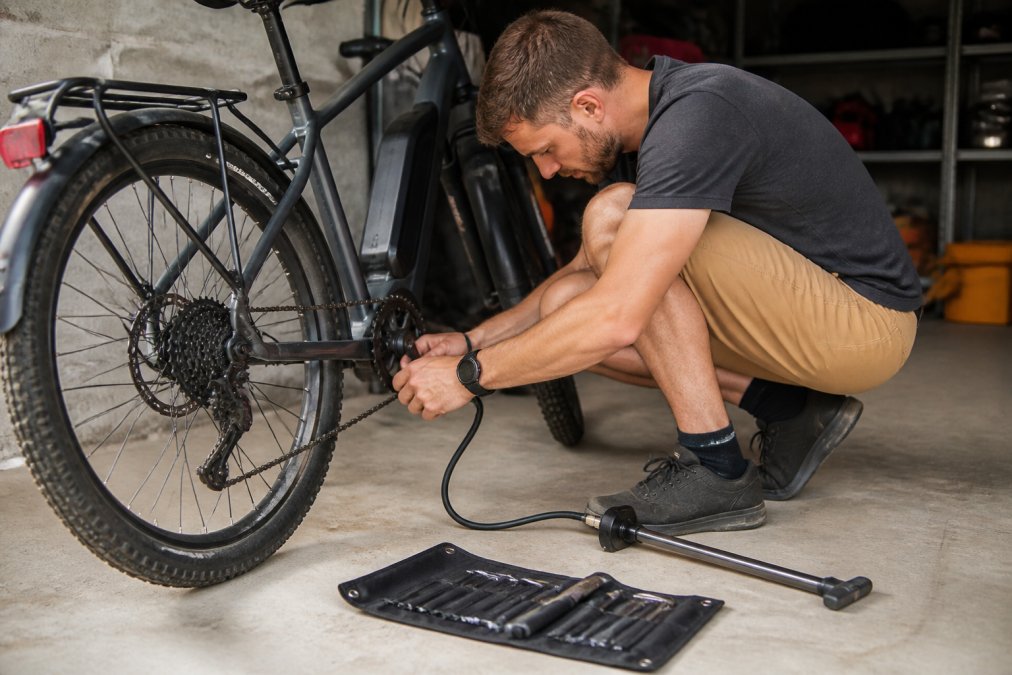
An electric bike annual maintenance checklist is a simple schedule of weekly, monthly, and yearly tasks that keep your bike safe and slow down wear. Follow it and most repairs become planned costs, not emergencies.
Weekly and Monthly Checks
Weekly checks take five minutes:
- Squeeze the tyres and top up pressure
- Spin the wheels and listen for rubbing
- Test both brakes at low speed
- Wipe the chain and add lube
Monthly, add a deeper look:
- Check brake pad thickness
- Inspect cables for fraying
- Clean the frame and battery contacts
- Confirm lights and sensors work
Yearly Safety Inspection
Book a professional safety inspection once a year. A technician checks torque settings, electrical diagnostics, and waterproofing, which are the areas beginners miss.
How to Maintain Electric Bike Battery Without Replacing It Early
Learning how to maintain electric bike battery health is the single biggest money-saver in this guide. A lithium-ion battery is the most expensive part on your bike, so protecting its cycle life matters more than any other habit.
Charging Habits That Protect Battery Cycle Life
- Charge between 20% and 80% for daily rides
- Avoid leaving it plugged in for days
- Store it cool, never in direct sun
- Use the charger that came with the bike
- Top up before long rides, not after every short one
Charging efficiency drops in cold weather, so expect shorter range in winter. That is normal, not a fault.
E-Bike Service Cost UK: What a Shop Charges and When to Book
E-bike service cost UK riders pay depends on the shop, the tier of service, and whether the work is mechanical or electrical. Most workshops price in one of three bands, and knowing which band you need stops you overpaying for a strip-down you did not require.
The Three Service Tiers
| Tier | Typical Work | Typical Labour Time |
|---|---|---|
| Safety check / basic tune | Brake and gear adjustment, bolt torque check, tyre pressure, quick electrical fault scan | 30-45 minutes |
| Interim service | Everything above, plus drivetrain clean, chain wear check, brake pad inspection, spoke tension | 1-1.5 hours |
| Full service | Everything above, plus wheel true, bearing check, motor and controller diagnostics, battery health report, waterproofing check | 2-3 hours |
Labour is charged by the hour, and electrical diagnostics usually sit at a higher hourly rate than mechanical work because the technician needs brand-specific software and training. A common pattern is for the electrical rate to run roughly a third higher than the mechanical rate. Ask your shop to quote both rates before booking so there are no surprises.
When to Book, by Mileage
This is the schedule most beginners never get told, and it is the single most useful thing you can pin to your garage wall.
- Every 500 miles, interim service. Chain wear check, brake pad thickness, drivetrain clean, bolt torque.
- Every 1,000 miles, full service. Add wheel true, bearing inspection, and a battery health readout.
- Every 2,000 miles, full service plus a drivetrain wear assessment. Expect to be told a chain, cassette, or chainring is due.
- Annually, regardless of mileage, safety inspection. A bike that has sat unused still needs its battery cycled, its hydraulics checked, and its tyres inspected for sidewall cracking.
DIY Repair vs Bike Shop Labour Rates
DIY saves the labour line but costs you tools and time. The trade-off is only worth it where the task is reversible and does not touch a sealed unit.
| Task | DIY Difficulty | When to Book a Shop |
|---|---|---|
| Chain cleaning and lube | Easy | Never |
| Brake pad replacement | Moderate | If unsure, or if brakes are hydraulic |
| Tyre and tube change | Moderate | Rear hub motors, or if the wheel has a torque sensor |
| Gear indexing | Moderate | If the derailleur hanger is bent |
| Battery or controller fault | Hard | Always |
| Motor bearing service | Hard | Always |
Energy Saving Trust guidance on charging and running costs
Mint Chain Cleaner 500ml Spray Can →
Replacement Parts, Tools and Cost-Saving Tips
A beginner tool kit does not need to be expensive. Start with:
- A track pump with a pressure gauge
- Tyre levers and a spare inner tube
- A multi-tool with hex keys
- Chain lube and a chain cleaner
- Nitrile gloves and a rag
For chain care, the Mint Chain Cleaner 500ml Spray Can at £7.49 dissolves dried lube and grit fast. Follow it with the Oxford Mint All Weather Lube 500ml at £7.99, which uses PTFE to fill gaps between moving parts and cut dirt ingress.


Cost-saving tips that work:
- Buy consumables in bulk before winter
- Clean your chain instead of replacing it early
- Rotate two chains to spread drivetrain wear
- Ask your shop about service bundles
Warranty, Battery Replacement and Long-Term Running Costs
Warranty covers manufacturing faults, not wear and tear. That single sentence is the most expensive thing a beginner can misunderstand, because it decides whether a repair is a free claim or a bill.
What Warranty Typically Covers, and What It Does Not
Most manufacturer warranties on e-bikes follow a similar shape, though the exact terms vary by brand and you should read yours before you need it.
Usually covered:
- Frame cracks and welds (often the longest cover, frequently several years)
- Motor failure not caused by water ingress or crash damage
- Battery cells that fail to hold charge within the stated cycle count
- Controller and display faults under normal use
Usually not covered:
- Brake pads, tyres, tubes, chains, cassettes, and cables, these are consumables by definition
- Battery capacity loss from normal ageing, which is expected, not a fault
- Water damage from pressure-washing or submerging
- Damage from crashes, overload, or unauthorised repairs
- Labour charges, even on a covered part, at many shops
Battery Replacement: The Big-Ticket Item
A lithium-ion battery is the most expensive single component on the bike. Its life is measured in charge cycles, and how you treated it decides whether you get the long end or the short end of that range.
Signs it is time to replace rather than repair:
- Range has dropped noticeably against when the bike was new, under the same route and weather
- The battery charges unusually fast and then drains unusually fast
- The display cuts out under load on hills
- The pack swells, rattles, or runs hot
Long-Term Running Costs vs Alternatives
Over a typical ownership period, an e-bike still undercuts most alternatives. There is no fuel, no road tax, no MOT, and insurance is not required by law for a standard pedal-assist bike. Charging a battery from empty costs a small fraction of a tank of petrol, and most commuters charge once or twice a week.
| Cost | Frequency | Notes |
|---|---|---|
| Consumables (pads, chain, tyres, cables) | Every 1,000-2,000 miles | Rises sharply in winter grit |
| Servicing | Every 500-1,000 miles | DIY reduces the labour line |
| Battery replacement | Every few years, depending on cycle care | The largest single outlay |
| Software or firmware updates | Occasional | Usually free at a dealer |
Frequently Asked Questions
Do electric bikes need a lot of maintenance?
No more than a standard bicycle, but the electrical side adds a few jobs. Expect chain lubrication, tyre pressure checks and brake pad inspection as routine tasks, plus occasional software firmware updates and electrical diagnostics. Budget roughly £100 to £250 a year for servicing, parts and consumables on a typical commuter e-bike, depending on mileage. Keeping on top of preventative maintenance is what stops small jobs turning into expensive repairs.
How often should an e-bike be serviced in the UK?
Book a full service every 6 to 12 months, or every 1,000 to 1,500 miles, whichever comes first. Commuters riding daily through wet winter roads should lean towards the 6-month mark because road salt and grit accelerate drivetrain wear. Between services, check tyre pressure weekly, lubricate the chain every 100 to 150 miles and inspect brake pads monthly. A yearly safety inspection at a bike shop is worth adding to your electric bike annual maintenance checklist.
Can I perform basic e-bike maintenance at home?
Yes, and doing so cuts your annual budget significantly. Chain cleaning, lubrication, tyre pressure and brake pad checks need only basic tools. A dedicated chain cleaner such as the Mint Chain Cleaner 500ml Spray Can at £7.49 makes the job quick, and a quality lubricant like Oxford Mint All Weather Lube 500ml at £7.99 extends maintenance intervals. Leave battery diagnostics, motor repairs and controller faults to a qualified shop.
What happens if the battery degrades after a year or two?
Lithium-ion batteries lose capacity gradually, typically holding 70 to 80 per cent of original range after several hundred charge cycles. Good habits, such as storing the battery between 20 and 80 per cent charge and avoiding full discharges, slow that decline. Check your warranty terms before buying, since most cover defects rather than normal degradation. A replacement battery is the single largest out-of-pocket cost an e-bike owner faces.