

How to Get 50+ Miles of Battery Range on a Commuter E-Bike
Last Updated: October 25, 2026
Quick Summary
A 50+ mile battery range on a commuter e-bike is realistic when the bike, rider and route line up, but advertised figures assume flat routes, mild weather and moderate assist. Plan a reserve of at least 20%, since a 50-mile-rated bike is a comfortable 35-40 mile commuter in practice.
- Watt-hours, calculated as voltage times amp-hours, tell you more about range than any marketing claim.
- Size the battery so advertised range is at least 1.5 times your round-trip commute distance.
- Cold below 5°C cuts range 10-20%, so a 50-mile summer pack is closer to 40 miles in January.
- A steady cadence in a lower gear often beats a high assist level for efficiency.
- A full charge on a typical commuter pack takes four to six hours, so plan charging at home and work.
Table of Contents
- What 50+ Miles of Battery Range Really Means for a Commuter E-Bike
- Electric Bike Range Per Charge: Watt-Hours, Voltage and Amp-Hours Explained
- E-Bike Battery Range Factors That Decide Your Real-World Figure
- How to Extend E-Bike Battery Range on Your Daily Commute
- E-Bike Battery Charging Time and Charging Logistics at Home and Work
- Battery Longevity, Replacement Costs and What to Check Before You Buy
- Book a Free Test Ride and Check Real Range Before You Commit
- Frequently Asked Questions
What 50+ Miles of Battery Range Really Means for a Commuter E-Bike
A battery range of 50+ miles on a single charge for commuter gear is a realistic target, but only when the bike, the rider and the route line up.
Here is the honest version: most commuter e-bike range figures are measured under favourable conditions.
Below, we break down what changes that number in practice, how to size a battery for your own round-trip commute, and what to check before you commit.
Why the Claim Needs Context: Speed, Assist Level and Rider Weight
Range claims collapse without context. A rider using the highest pedal assist setting on a hilly route will drain a battery far faster than someone on the lowest setting on flat tarmac.
Three variables do most of the work:
- Speed: higher assisted speeds increase energy consumption sharply
- Assist level: the top setting can cut range well below the average figure
- Rider weight and cargo: a heavier rider with loaded panniers uses more energy per mile
A common mistake is buying on the headline number alone. In practice, the range you get is the range your commute allows. If your route is 20 miles round trip with two steep climbs, a single-battery setup rated at 50 miles leaves you a sensible margin. If it is 40 miles round trip, that margin gets thin.
Electric Bike Range Per Charge: Watt-Hours, Voltage and Amp-Hours Explained
Electric bike range per charge is driven by battery capacity, measured in watt-hours (Wh). Watt-hours are calculated by multiplying voltage by amp-hours, so a 48V 17.8Ah battery holds roughly 854Wh of energy. That single figure tells you more than any marketing claim.
Voltage also shapes how the bike feels. A 48V system delivers power differently from a 36V one, and a 500W or 750W motor draws energy faster than a 250W unit. Bigger motor, more draw, shorter range from the same battery pack.
Estimating Your Range from Battery Capacity
A rough planning rule: divide watt-hours by your expected consumption per mile. Consumption varies with terrain, assist level and weight, so treat any estimate as a starting point and confirm it on your own route. The table below shows the planning figures most commuter riders land on after a few weeks of riding.
| Battery capacity | Typical assisted consumption | Estimated range (mixed commute) |
|---|---|---|
| 360Wh (36V 10Ah) | 8-10Wh per mile | 36-45 miles |
| 500Wh (36V 14Ah) | 8-10Wh per mile | 50-62 miles |
| 625Wh (48V 13Ah) | 9-11Wh per mile | 57-69 miles |
| 854Wh (48V 17.8Ah) | 9-11Wh per mile | 78-95 miles |
| 1,040Wh (52V 20Ah) | 10-12Wh per mile | 87-104 miles |
Those figures assume a 75kg rider, moderate hills, mixed assist levels and mild weather. Add 20% for a heavier rider or a hilly route, and subtract 15-20% for winter temperatures.
Why a 50-Mile Claim Is Not a 50-Mile Commute
A bike advertised for 50 miles may not reliably cover a 50-mile commute, because the advertised figure is typically measured on a flat route at moderate speed in mild weather with a lighter rider. For a daily round trip, plan a reserve of at least 20% for detours, aging, cold snaps and the days you use the top assist setting. In practice, a 50-mile-rated bike is a comfortable 35-40 mile commuter, and a 60-70 mile-rated bike is the safer choice for a 50-mile round trip.
For a deeper look at how to test your own bike's real range, see our guide on how to test e-bike battery range.
E-Bike Battery Range Factors That Decide Your Real-World Figure
E-bike battery range factors stack up quickly. No single variable decides your real-world figure; it is the combination that matters. The table below shows the approximate effect each factor has on a 50-mile rated commuter e-bike, based on the common pattern seen across manufacturer testing and rider reports.
| Factor | Typical effect on range | Mechanism |
|---|---|---|
| Rider weight and cargo | 10-25% reduction for every 20kg above a 75kg rider | More mass means more energy per acceleration and per climb |
| Hills and gradients | 20-40% reduction on a route with repeated climbs | Climbing draws high current for sustained periods |
| Assist level | 30-50% reduction at the top setting versus the lowest | Higher assist means the motor contributes more torque per pedal stroke |
| Speed | 15-30% reduction riding at 25km/h versus 20km/h | Air resistance rises with the square of speed |
| Temperature | 10-20% reduction below 5°C | Cold slows the chemical reaction inside lithium cells |
| Tyre pressure and surface | 5-15% reduction on soft or rough surfaces | Higher rolling resistance |
| Motor power | 10-20% reduction with a 500W+ motor versus 250W | Bigger motor draws more current under load |
Rider Weight, Cargo Load, Hills and Road Conditions
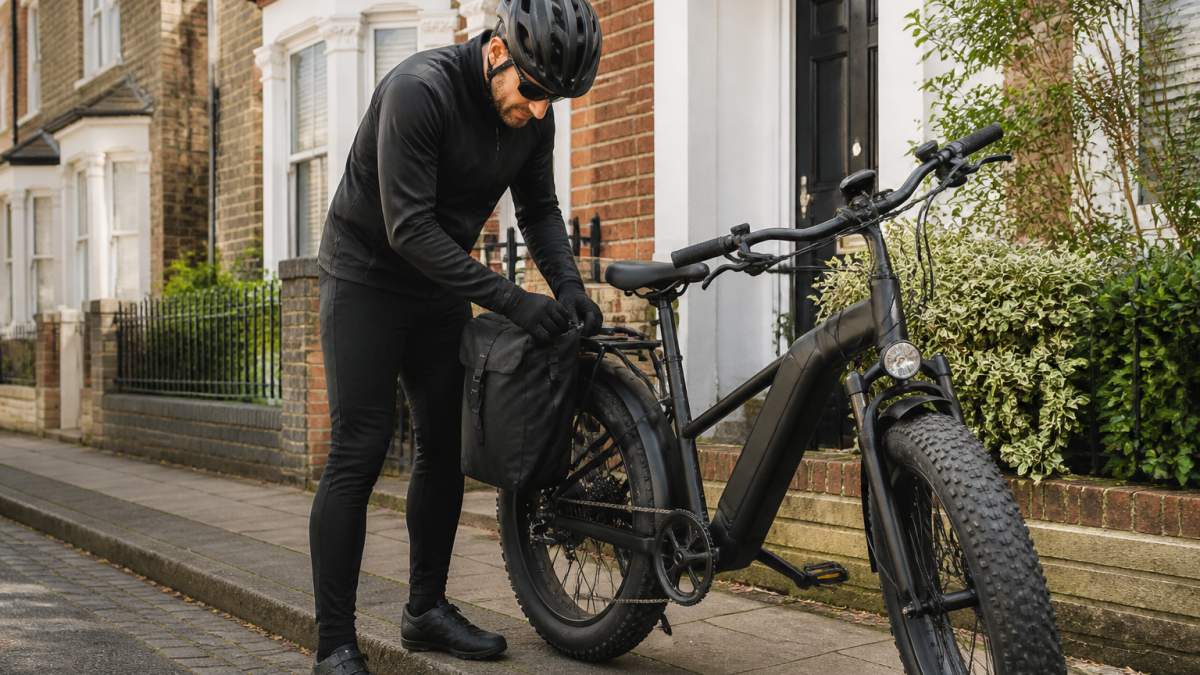
A heavier rider with a loaded pannier rack uses more energy than a lighter one on the same route. Hills amplify this: climbing draws far more current than cruising on the flat, and repeated climbs on a daily commute add up over the week. Road conditions matter too. Rough surfaces, frequent stops and headwinds all increase drain. So does riding style.
The thing nobody tells you about range testing is that a steady cadence in a lower gear often beats a high assist level for efficiency. It is less about the bike and more about how you ride it.
Weather, Temperature and Motor Efficiency
Cold weather is the factor most commuters underestimate. A lithium battery that delivers 50 miles in July may deliver closer to 40 miles in January, because low temperatures slow the chemical reaction inside the cells and temporarily reduce usable capacity. The effect is reversible: the pack warms up as you ride, and capacity returns in milder weather.
G-Hybrid Husky VM6 Electric Bike 50 Miles Range →
Motor efficiency matters too. A 250W mid-drive motor running through the bike's gears is generally more efficient on hills than a 250W hub motor, because it can use the bike's gear range to keep the motor in its efficient band.
How to Extend E-Bike Battery Range on Your Daily Commute
Extending range comes down to a handful of habits that cost nothing. Start with assist level: drop it one notch on flat sections and save the top setting for the climbs.
- Keep tyres at the correct pressure to reduce rolling resistance
- Pedal with a steady cadence rather than surging and coasting
- Plan a route with fewer stops and gentler gradients where possible
- Avoid carrying unnecessary weight in panniers
- Charge to full before long days and top up at work if you can
If you want to know what your bike actually delivers, read our guide on how to test e-bike battery range on your own route. And if you are still assembling your setup, our piece on the essentials for commuting by bike covers the kit that makes a daily ride practical.
E-Bike Battery Charging Time and Charging Logistics at Home and Work
E-bike battery charging time typically runs four to six hours for a full charge on a commuter pack. That is long enough to make charging logistics part of your buying decision, not an afterthought.
At home, a standard indoor socket and a dry, room-temperature spot near the bike are enough.
Watch out: charging in a cold shed or leaving a battery on charge unattended overnight in an unheated space shortens its working life. Keep the pack indoors and charge it where you can keep an eye on it.
Battery Longevity, Replacement Costs and What to Check Before You Buy
Battery longevity is the ownership cost most buyers underestimate. A lithium pack loses capacity gradually with every charge cycle, and how you treat it decides whether it stays strong for years or fades early (pubmed.ncbi.nlm.nih.gov).
What to check before buying:
- Whether the battery is removable and replaceable
- The stated charge cycle life and warranty terms
- Whether the brand offers battery testing as part of servicing
- The cost and availability of a replacement pack
Our article on 7 ways to extend electric bike battery life goes deeper on protecting the pack. As a Leicester-based shop, we also run battery testing and servicing through our after-care team, so you are not left guessing when capacity starts to slip.
Book a Free Test Ride and Check Real Range Before You Commit
The only reliable way to know whether a commuter e-bike will cover your round-trip commute is to ride it on terrain like yours. A test ride tells you more about real-world range than any specification sheet.
If you want to see the specification behind a 50-mile claim, the G-Hybrid Husky VM6 electric bike pairs a 48V 17.8Ah Sanyo battery with a 250W/750W brushless motor, five assist levels, a Shimano 7-speed gear system and front and rear disc brakes.

For guidance on how range figures are reached and how to plan a commute around them, the Energy Saving Trust guidance on electric bikes is a useful independent reference, and the UK government guidance on electrically assisted pedal cycles sets out the rules that keep a commuter e-bike road-legal.
Frequently Asked Questions
Can a commuter e-bike really travel 50 miles on one charge?
Yes, but only under the right conditions. A model like the G-Hybrid Husky VM6, with its 48V 17.8Ah battery, is rated for up to 50 miles when ridden at average speeds below 25km/h on the 250W motor setting. Heavier riders, steep hills, high assist levels and cold weather will all pull that figure down. Treat 50 miles as a best-case figure and plan a margin for your own commute.
How accurate are e-bike range estimates?
Manufacturer figures are usually measured on flat ground, at moderate speed, with a lighter rider and low assist. Your real-world range will differ. The most reliable approach is to calculate from watt-hours, then subtract 20-30% as a safety margin. A standardized test on your own route, with your own cargo, tells you more than any brochure number.
How long does it take to charge an e-bike battery?
Most commuter e-bike batteries charge in four to six hours from empty, which suits an overnight charge at home. The G-Hybrid Husky VM6's Sanyo battery takes four to six hours. If you can charge at work as well, a partial top-up over lunch can extend your daily range considerably without a second battery.
Does carrying commuter gear reduce e-bike range?
It does. Every extra kilogram, whether from a laptop bag, panniers or shopping, adds to the energy the motor must deliver. A loaded commute can cut range by a noticeable margin compared with an unladen test ride. Factor your typical load into your range estimate, and keep tyre pressures correct to limit the effect.
The challenge is simple: a range claim is only useful if it matches your route, your weight and your riding style. We would rather you ride the bike and see the real figure than take a number on trust. Green Hybrid Bikes offers free test rides at our Leicester showroom, battery testing and servicing through our UK after-care team, and UK-wide delivery on our commuter range. Get started with Green Hybrid Bikes and book a free test ride to check real range before you commit.

